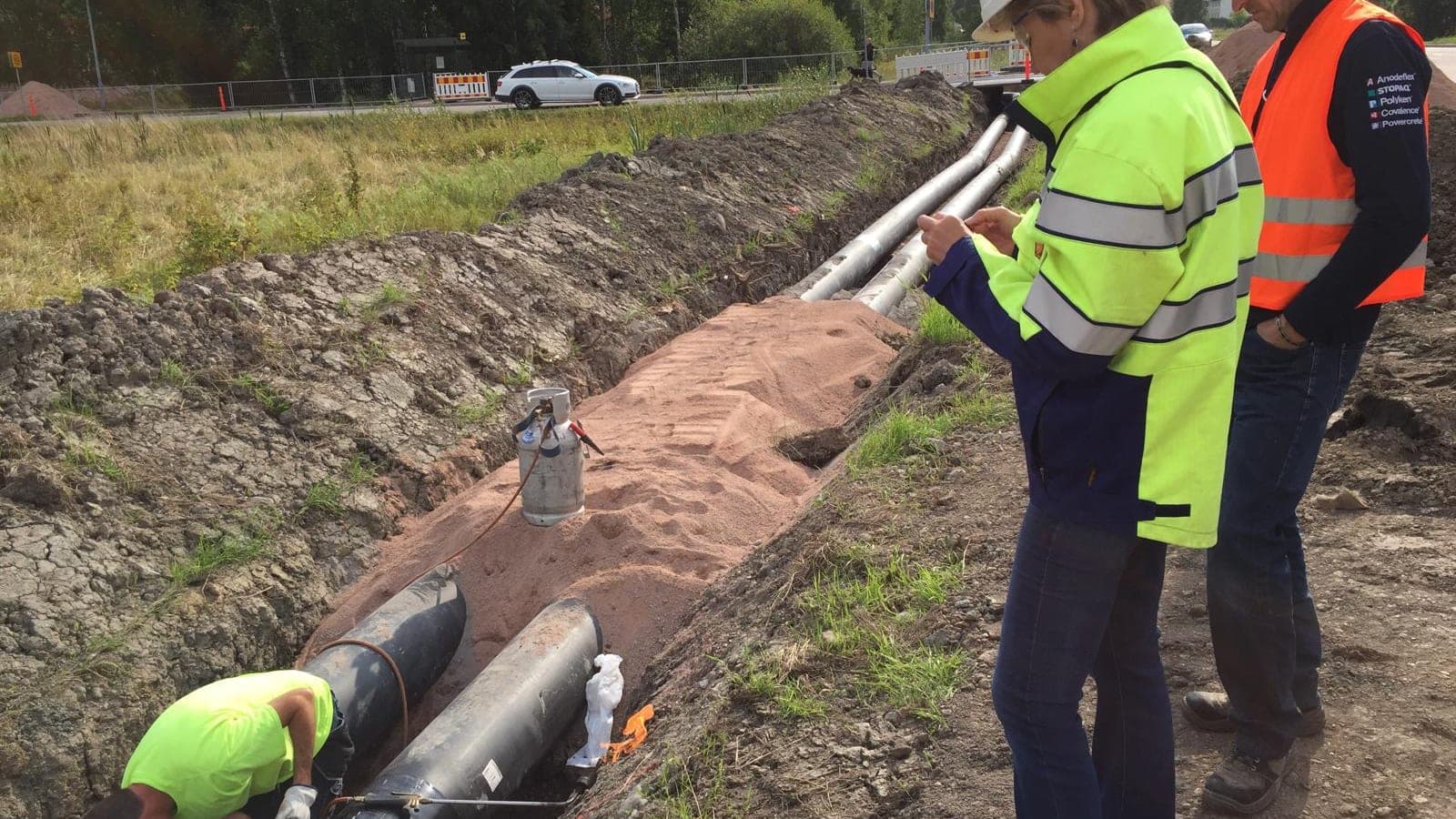
A long buried steel pipe is coated at the factory. The factory coating is uniform, tested and continuous along the full length of the pipe section. The pipe sections are welded together on site, and at each weld a strip of bare steel is left with no factory coating. This is the field joint.
The field joint is where the factory-made coating ends and the site-applied protection begins. It is the weakest link in the line, because it is made in the field, in weather conditions, by hand. That is exactly why joint protection has its own international standard, ISO 21809-3, and the district heating joint has its own European standard, EN 489.
This is a buyer's selection guide. We go through which two distinct jobs the joint protection actually performs, which standard each one is based on, and the logic for choosing the right product family from three: Stopaq, Covalence or BG Industry.
ISO 21809-3 and what the standard actually covers
ISO 21809-3 is the part of the standard series that deals specifically with field joint coating for buried and submerged steel pipelines. The other parts of the series cover factory-applied coatings. Part 3 covers the strip that the installer makes themselves on site.
The standard classifies joint protection by type. From Kampek's range, Stopaq Wrappingband CZH is a Type 13 viscoelastic wrap and Stopaq Outerwrap PE is a Type 13A mechanical protective tape. The number indicates which type class the product belongs to. It is not a ranking of quality.
An important boundary: ISO 21809-3 applies to the Stopaq family, which is external corrosion protection for bare steel. A pre‑insulated district heating pipe joint is assessed by a different standard. The district heating joint has its own standard, EN 489, and the two should not be applied to each other.
Stopaq Wrappingband is a Type 13 viscoelastic corrosion wrap under ISO 21809-3, applied cold without primer, and wire brushing to cleanliness grade St 2 is enough.Stopaq Wrappingband CZH, PDS V13
Two distinct jobs: corrosion protection and mechanical support
In practice the joint protection performs two distinct jobs, and they are worth thinking about separately. The first is corrosion protection, that is, sealing. The steel surface has to be closed off from moisture and oxygen so that corrosion cannot start. This is done by the viscoelastic compound, which bonds to the steel and flows into the surface irregularities.
The second job is mechanical protection. On top of the corrosion protection you need a layer that withstands the stones in the trench, the backfilling of the pipe and the movement of the soil without damaging the sealing underneath. This is done by a mechanical protective tape or a hard jacket layer.
In the Stopaq system these two jobs are separate products. Wrappingband CZH handles the corrosion protection, and Outerwrap PE is applied over it as mechanical protection. The buyer should check that both jobs are covered. A corrosion wrap alone without mechanical protection is vulnerable to damage during the backfilling stage.
Why corrosion strikes the joint in particular
The mechanism of corrosion in soil is simple. When moisture, oxygen and bare steel are in contact at the same time, the steel starts to corrode. A factory-coated pipe section is protected, because the steel is isolated from moisture. The joint is a risk point, because there the steel is bare for a moment and the protection is applied in the field.
If the joint protection leaves even a small gap, moisture gets in and stays against the steel surface. The damage is not visible from the outside, because it is underground. It is often detected only when the pipe leaks or when the line is dug up for some other reason.
For this reason what is decisive for the joint protection is how well the compound bonds to the steel and whether it fills the surface irregularities. Stopaq's viscoelastic polyisobutylene compound stays soft, flows into the irregularities and repairs itself from small damage. No curing takes place. This way no space for moisture is left between the steel surface and the protection.
Stopaq: when the geometry is irregular or the steel is bare
Stopaq is the right choice when the object to be protected is bare steel or cast iron and the geometry is irregular. In practice this means welded joints, bends, flanged connections, valves and other fittings that a prefabricated sleeve or wrap does not fit. The viscoelastic compound forms to the shape of the object by hand.
Stopaq Wrappingband CZH meets the requirements of ISO 21809-3 (Type 13) and EN 12068 (KIWA), and it additionally has NSF/ANSI 61 approval, which opens up use in municipal drinking water networks. According to the datasheet its operating temperature is -45 °C ... +70 °C, and short term +90 °C. No sandblasting and no primer is needed for installation, and wire brushing to cleanliness grade St 2 is enough.
The practical benefit for the buyer is two things. Cold application without a flame means that in many cases the pipe can stay in service for the whole job. In addition, according to the manufacturer the compound does not interfere with cathodic protection, so Stopaq and cathodic protection work side by side on long buried transmission lines. For the annular space of casing pipes, for example in road and rail crossings, Stopaq Casing Filler is used separately.
Covalence and BG Industry: the district heating joint is its own special case
A pre‑insulated district heating pipe is structurally different from a bare transmission line. It has a steel flow pipe, polyurethane foam insulation and a polyethylene jacket around it. When such a pipe is jointed, the joint involves sealing the jacket and refilling the insulation. This is not about protecting bare steel. Here EN 489 applies. ISO 21809-3 governs the coatings of bare buried steel pipelines instead.
Covalence RJS-E is a wraparound heat‑shrink sleeve with a cross-linked PE-X backing and a dual adhesive: an anchoring hot-melt adhesive at the edges and a viscoelastic sealing compound in the centre. It covers casing pipes 90-1200 mm, so it also flexes to repair work and non-standard dimensions. BG Industry manufactures prefabricated heat‑shrink sleeves from jacket-grade HDPE PE 100 with a butyl sealant, in size classes DN 90-450.
Both are type-tested to the EN 489:2009 standard at the German FFI (Fernwärme-Forschungsinstitut). The basis of the standard is a designed service life of at least 30 years, and the type tests include a soil-stress test and a water‑tightness test. Note that EN 489 type testing applies to the heat‑shrink sleeve joint itself. It does not cover every accessory separately.
Selection logic: geometry, temperature and size range
The choice goes through three questions. First: is this a pre‑insulated district heating pipe or a bare steel line? A district heating pipe joint is sealed with Covalence's heat‑shrink sleeve or BG Industry's heat‑shrink sleeve according to EN 489. Bare steel as well as gas and oil lines and all irregular geometry go to Stopaq's viscoelastic protection according to ISO 21809-3.
Second: is the geometry regular or irregular? For a standard-size straight joint a prefabricated sleeve (BG Industry) is the fastest. For a wide size range and for repairs a wraparound wrap (Covalence) flexes best. Bends, valves and flanges are Stopaq's territory, because the compound forms to any shape.
Third: temperature and size range. Check the operating temperature from the product-specific datasheet, because the values vary. According to the datasheet the operating temperature of the Covalence RJS-E sleeve is at most 50 °C and that of Stopaq Wrappingband is -45 °C ... +70 °C. When it comes to service life, stick to the datasheets: the systems are designed to last in the soil for the whole service life of the pipe, and no number of years is stated for an individual product. Kampek supplies all three families from the same warehouse in Tuusula, so the choice is made according to the project and not according to availability.
Kampek's role and where the installation instructions come from
Kampek is the importer and warehouse keeper of these product families in Finland. Kampek is not the manufacturer. In practice this means that we help with the choice of product family and size according to the project, and we deliver the right combination across Finland.
Detailed installation instructions and up-to-date datasheets come from the manufacturer. For Covalence and Stopaq they come from Seal for Life, and for BG Industry from BG Industry. We link directly to their pages so that the instructions stay up to date. You get product advice and help with the choice from us by phone.
If you have a line in design or under contract and it is unclear which standard and family fits, call before you specify. The wrong standard for the wrong family is a common mistake, and it is easiest to correct before ordering.