

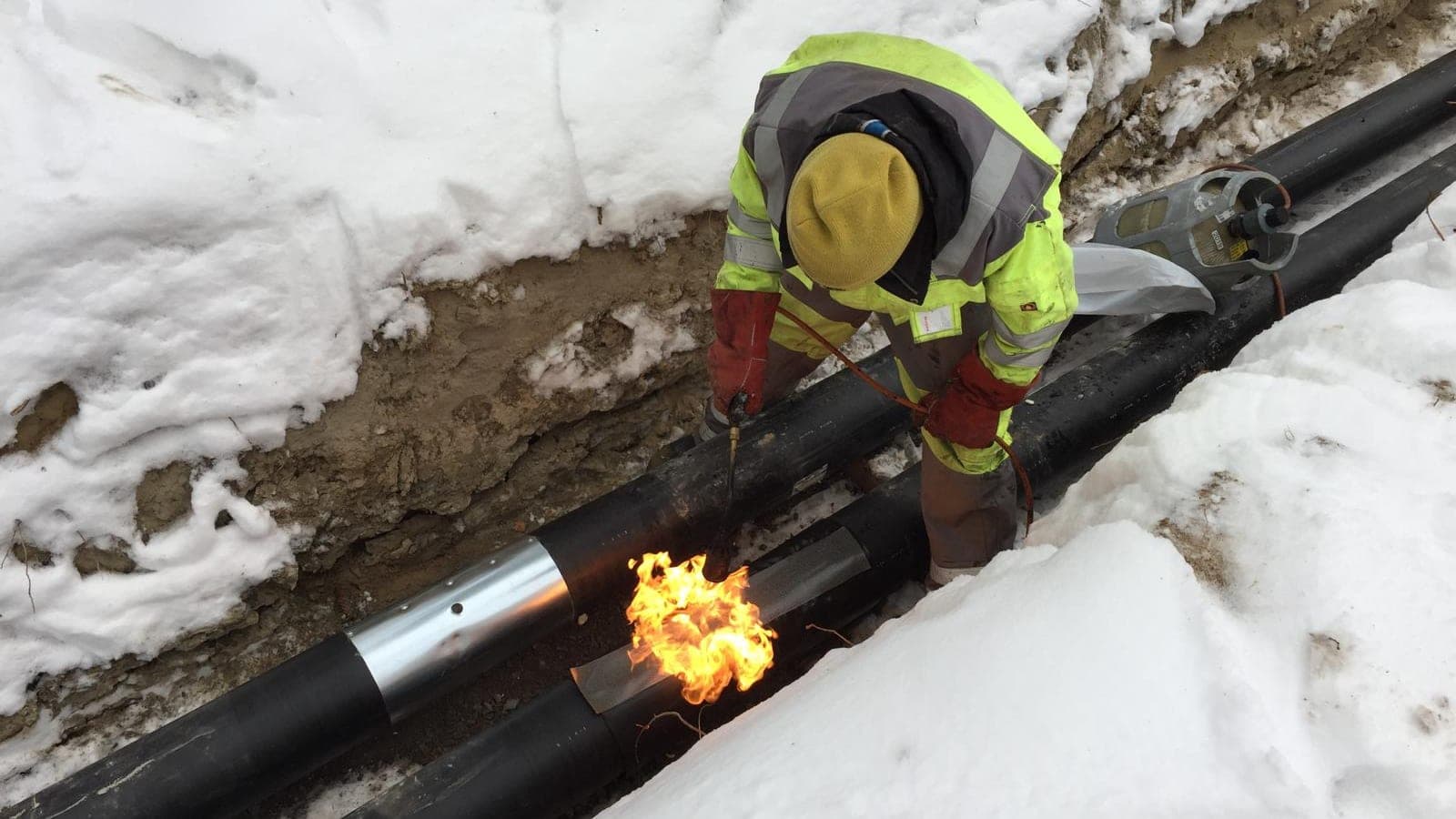
The joint of a pre‑insulated district heating pipe is the weakest link in the line. The pipe itself is factory-made and its jacket holds up, but the field joint made in the trench decides whether moisture can reach the space between the jacket and the casing pipe. Once water gets in, the insulation gets wet, heat losses rise and corrosion of the steel begins. The joint seal is the point where the service life of the whole network is either preserved or lost.
BG Industry's prefabricated shrink sleeve is one way to seal this joint. It is made from jacket-grade HDPE PE 100 polyethylene, the same material as the pre‑insulated pipe's own jacket, and the seal is a butyl compound. The structure is simple and repeatable, which makes it a natural choice for standard-size new lines.
In this article we go through what the sleeve is made of, how it works, what the EN‑489‑1:2019 type testing actually applies to, and when a prefabricated sleeve is a good choice compared with a wraparound shrink sleeve. Kampek imports and stocks BG Industry products but does not manufacture them. Detailed installation instructions always come from the manufacturer, and we help with selecting the application and size by phone.
The advantage of a prefabricated sleeve: standard sizes and speed in new builds
A prefabricated sleeve is a piece already made to the right size and shape, placed between the two pipe ends. Once the joint area is assembled, the sleeve is heat-shrunk tightly around the jacket and the butyl compound seals the connection. The whole joint follows the same repeatable pattern time after time, and the installer does not need to measure and cut a film to fit.
This repeatability is the core of the matter. In a new build, the pipe sizes are known in advance and follow the DN series. BG Industry's shrink sleeve is available in size classes DN 90, 110, 125, 140, 160, 180, 200, 225, 250, 280, 315, 355, 400 and 450, so the majority of joints in a normal distribution network fall directly into the standard series. When every joint is made the same way, the chance of error decreases and the work progresses at a steady pace.
A prefabricated sleeve needs only heat and pressure. No welding is required. This reduces the steps related to gas cutting and hot work in the trench. The joint is also leak-testable, meaning its dryness can be verified before the trench is backfilled.
BG Industry's butyl-sealed shrink sleeve is type-tested to EN‑489‑1:2019 at the independent Veolia Energy Warsaw testing laboratory, and the standard's design basis is a service life of at least 30 years.EN‑489‑1:2019 / Veolia Energy Warsaw, tyyppitestiraportit 30.01.2026
HDPE PE 100 material: the same jacket grade as the pipe casing
The sleeve's body material is high-density polyethylene PE 100, pipe grade. The same material is the basis of the pre‑insulated district heating pipe's own jacket. When the joint protection and the pipe jacket are the same polyethylene grade, they behave the same way under heat, ground movement and years of stress.
The material choice here is deliberately boring in a good way. PE 100 is a globally established, proven pipe material whose behaviour is well understood. Over the design horizon of a district heating network, this means the sleeve provides decades of protection without the material itself being a question mark.
In higher sleeve versions, the structure includes, in addition to the PE 100 body, a separate shrink film and PUR foaming. These are used when the insulation at the joint is to be restored to factory level and a purely mechanical and moisture-tight protection is not enough. In the basic sleeve, however, the load-bearing material is always the same PE 100 jacket grade.
Butyl compound seal: joint tightness and long-lasting grip
A shrunk polyethylene shell alone is not enough to keep out moisture. The jacket surface is rarely perfectly smooth, and small irregularities remain at the edges of the sleeve. The butyl compound is the part that fills these gaps and forms the actual moisture barrier between the sleeve and the pipe jacket.
Butyl stays tacky and pliable and does not cure into a hard surface. When the sleeve is shrunk, the combined effect of heat and pressure presses the butyl against the jacket and it flows into the surface depressions. This is essential for the tightness of the joint, because the seal works its way precisely into the points where water would otherwise get in.
The permanent pliability of butyl is also an advantage for a long service life. In the ground, the pipe and joint move with heat and ground movement. A rigid seal could crack over time, but the pliable butyl flexes with the movement and maintains the seal.
EN‑489‑1:2019 type testing: soil stress and water tightness
EN‑489‑1:2019 is the European standard for joints of pre‑insulated district heating pipes. It is more than a material designation, because it defines the type tests by which the durability of a joint is demonstrated. The key ones are the repeated soil stress test, in which the joint is loaded as the soil in the trench would load it, and the water tightness test, which verifies that water does not get into the structure.
BG Industry's butyl-sealed shrink sleeve is type-tested to EN‑489‑1:2019 at the Veolia Energy Warsaw testing laboratory, accredited by the Polish accreditation centre PCA (AB 414). The type test reports were issued on 30.01.2026. The laboratory is an independent third party, and its type testing is widely recognised on the district heating side as evidence that a joint passes the requirements of the standard.
An important clarification on the 30-year figure. The design basis of EN‑489‑1:2019 is a service life of at least 30 years. This is a property of the standard, and it is not a guarantee for an individual product. The correct way to talk about it is to state that the sleeve is tested to the standard, whose design basis is at least 30 years. As for the sleeve itself, we speak of decades of protection qualitatively and do not promise an exact number of years.
What the type testing applies to and what it does not
EN‑489‑1:2019 type testing applies to the shrink sleeve joint itself, that is, a straight joint between two pipes of the same size. This is the structure that has been put through the type tests and for which the requirements of the standard have been demonstrated.
Not all accessories in the sleeve family fall separately under the same type testing. For example, T-sleeves intended for branches and end sleeves intended for line terminations are their own product groups. For these, it is worth checking on a case-by-case basis which documentation and certification applies to that particular part.
When something other than a straight joint is needed at the joint location, it is worth getting in touch and looking together at which product version and which documents suit the application. Kampek provides product advice by phone, and detailed installation and certification information comes from the manufacturer's own documentation.
Straight joints, reducer sleeves and end caps for different lines
A straight shrink sleeve is the basic tool when two pipes of the same size are connected. This covers the majority of distribution network joints in the DN series between DN 90 and DN 450. The work is straightforward and repeatable, which is exactly the advantage for which a prefabricated sleeve is used on standard lines.
A reducer sleeve is needed when two jackets of different diameters are connected to each other. It is available both as a straight version and as a weld reducer, in which the sleeve is fitted to the butt weld of the carrier pipe. Diameter pairs are available widely, for example from DN 90/110 all the way up to DN 400/450, so changes in line size are handled with the same product family.
An end sleeve closes a pipe line termination and the pipe end. It is available in a screw-cap version, allowing the end to be opened when needed, for example for venting or closing. Branches are handled with separate T-sleeves. In this way the same system covers straight sections, size changes, branches and terminations.
What to choose: shrink sleeve or wraparound film
A prefabricated shrink sleeve and a wraparound shrink film solve the same problem in different ways. The sleeve is a finished piece for a standard size. The film, such as Seal for Life Industries' Covalence RJS-E, is a wraparound solution whose size range is adjusted by the width of the film and which covers a very wide range of casing pipe diameters.
A prefabricated sleeve is a natural choice for a new build where the sizes are standard, follow the DN series, and where speed and repeatability are decisive. When the same size is jointed many times, a finished sleeve keeps the work steady and predictable.
A wraparound film comes into play when the location has non-standard dimensions, very large diameters, or repair sites where more flexibility is needed than a finished sleeve can provide. The practical choice is often a combination: standard lines with the sleeve and special locations with the film. If a location is unclear, it is worth calling, and we will look at which one achieves the best result in that particular trench.